Photos
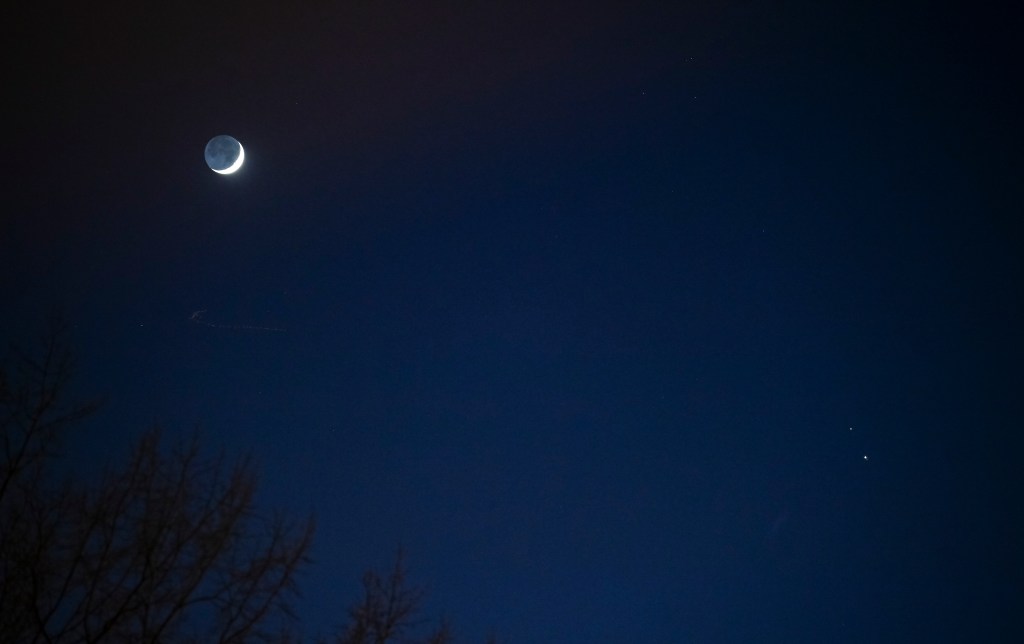
The Moon, left, Saturn, upper right, and Jupiter, lower right, are seen after sunset from Washington, DC, Thurs. Dec. 17, 2020. The two planets drew closer to each other in the sky as they headed towards a “great conjunction” on Dec. 21, where the two giant planets appeared a tenth of a degree apart.
Image Credit: NASA/Aubrey Gemignani
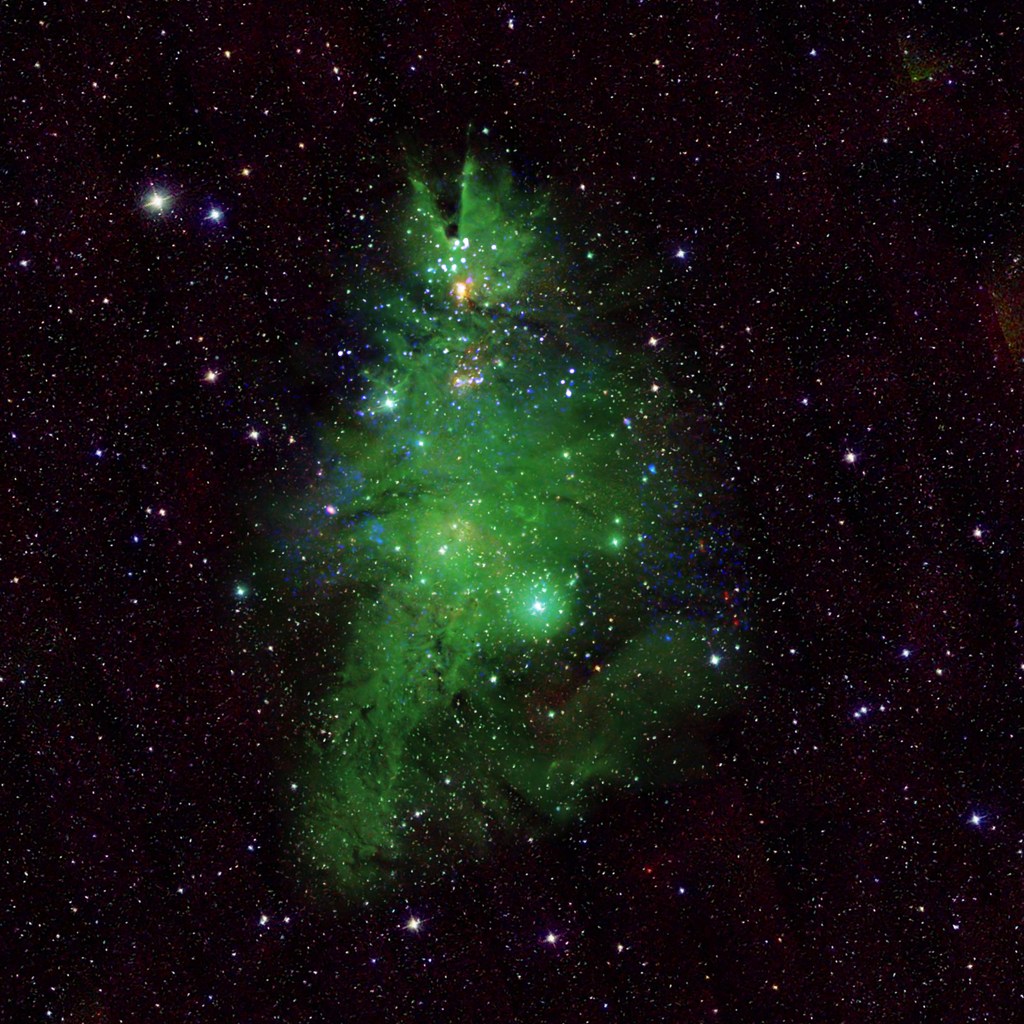
This composite image shows the Christmas Tree Cluster. The blue and white lights (which blink in the animated version of this image) are young stars that give off X-rays detected by NASA’s Chandra X-ray Observatory. Optical data from the National Science Foundation’s WIYN 0.9-meter telescope on Kitt Peak shows gas in the nebula in green, corresponding to the “pine needles” of the tree, and infrared data from the Two Micron All Sky Survey shows foreground and background stars in white. This image has been rotated clockwise by about 160 degrees from the astronomer’s standard of North pointing upward, so that it appears like the top of the tree is toward the top of the image.
Image Credit: X-ray: NASA/CXC/SAO

NASA’s James Webb Space Telescope’s new view of Cassiopeia A (Cas A) in near-infrared light is giving astronomers hints at the dynamical processes occurring within the supernova remnant. Tiny clumps represented in bright pink and orange make up the supernova’s inner shell, and are comprised of sulfur, oxygen, argon, and neon from the star itself. A large, striated blob at the bottom right corner of the image, nicknamed Baby Cas A, is one of the few light echoes visible NIRCam’s field of view. In this image, red, green, and blue were assigned to Webb’s NIRCam data at 4.4, 3.56, and 1.62 microns (F444W, F356W, and F162M, respectively).
Image Credit: NASA, ESA, CSA, STScI, D. Milisavljevic (Purdue University), T. Temim (Princeton University), I. De Looze (University of Gent)

 Launch Point